Over the last few years, I have been questioning a lot how art therapy is done. I am rethinking how it can be decolonized, deconstructed, and rethought. Decolonial, indigenous, abolitionist, and mutualist anarchist concepts serve as inspiration, interwoven with one another. These find their way into my research, teaching, and practice. My goal is to build and inspire an internationalist concept of total liberation within the field and the community. With it, the good life for all should become part of a contemporary art therapy canon.
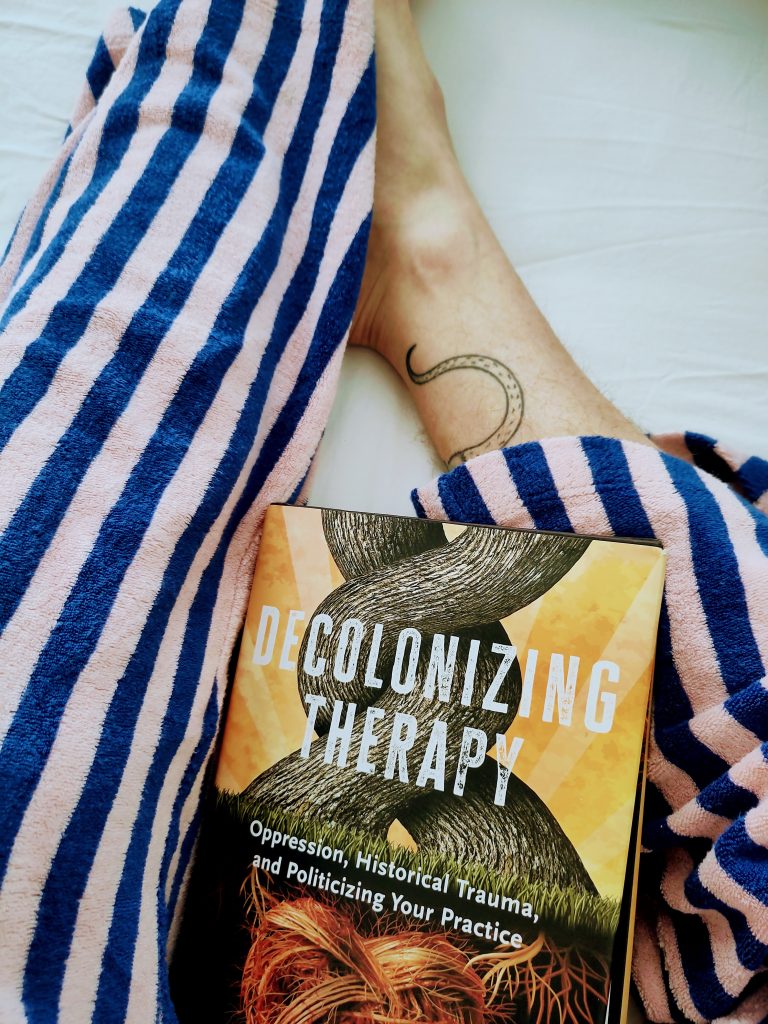
There is no compendium full of „recipes“ on how to decolonize rather than a radical self-reflective and power-critical attitude. Also, there is a bundle of various concepts designed to inspire a reorientation of the discipline. And they come with an urgent call to get into action and implement solidarity, care, and revolution into art therapy which is often still practiced exactly as it was in the 1980s and 1990s. This means making full use of the capacity art therapy can bring for processes of social change. We urgently need to address and criticize historically Eurocentric medical-model therapies. These therapies center individual pathologization and white cishet middle-class able-bodied neuronormative frameworks. They marginalize everything and everyone outside this norm, such as Indigenous and collective healing practices. By positioning care itself as a revolutionary act, we can move beyond these restrictive paradigms. This opens the way towards a liberatory practice of art therapy.
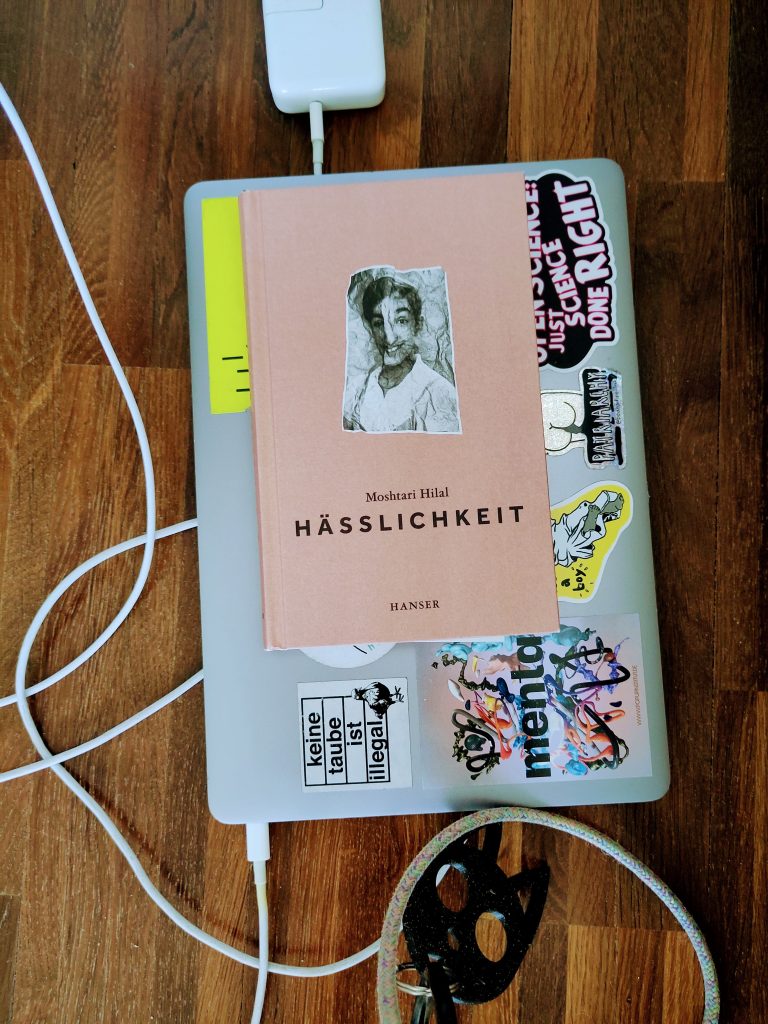
So, here’s my postdisciplinary to-read list. It‘s a collection some of the literature I went through that helped me to unlearn and relearn. Feel free to add other literature on this topic in the comment section.
Not everyone can afford to buy (new) books. So feel free to check out secondhand book marketplaces like Booklooker or ask your public library to purchase the book you’re looking for. These options are also sustainable.
books
Aktaş, U. (2020). Vulnerabilität: Pädagogisch-ästhetische Beiträge zu Korporalität, Sozialität und Politik (Vol. 12). transcript.
Chatzidakis, A., Hakim, J., Litter, J., & Rottenberg, C. (2020). The care manifesto: The politics of interdependence. Verso Books.
Davis, A. Y. (2011). Abolition democracy: Beyond empire, prisons, and torture. Seven Stories Press.
Hartman, S. (2008). Lose your mother: A journey along the Atlantic slave route. Macmillan.
Hilal, M. (2023). Hässlichkeit. Carl Hanser.
hooks, b. (2000). All about love: new visions. William Morrow.
Kaishian, P. O. (2025). Forest Euphoria: The Abounding Queerness of Nature. Spiegel & Grau LLC.
Kilomba, G. (2021). Plantation memories: Episodes of everyday racism (Vol. 6). Unrast.
Kurt, S. (2023). Hass: Von der Macht eines widerständigen Gefühls. HarperCollins eBook.
Kurt, S. (2021). Radikale Zärtlichkeit: Warum Liebe politisch ist. HarperCollins.
Mageary, J. (2020). Zines, the DIY ethic, and empowering marginalized identities. In L. Leone (Ed.), Craft in Art Therapy (pp. 177-189). Routledge.
Mullan, J. (2023). Decolonizing therapy: Oppression, historical trauma & politicizing your practice. WW Norton & Company.
Ndikung, B. S. B., Agudio, E., & Krugman, K. (2020). Ultrasanity. Über Wahnsinn, Hygiene, Antipsychiatrie und Widerstand. SAVVY Contemporary.
Saase, S., Namdiero-Walsh, A., Schlör, S., & Dücker, K. (2025). Intersektionalität in Therapie und Beratung. https://doi.org/10.5771/9783748940104
Sharman, Z. (2021). The care we dream of: Liberatory and transformative approaches to LGBTQ+ health. Arsenal Pulp Press.
Simpson, L. B. (2026). Theory of water: Nishnaabe maps to the times ahead. Random House.
Somerville, S. B. (2000). Queering the Color Line: Race and the Invention of Homosexuality in American Culture. Duke UP.
Talwar, S. K. (2018). Art therapy for social justice: Radical intersections. Routledge.
paper
Bönkost, J. (2016). Weiße Emotionen: Wenn Hochschullehre Rassismus thematisiert. IDP Paper, 1. https://www.jule.boenkost.de/docs/IDB%20Paper%20No%201.pdf
Conlin, S. E. (2017). Feminist therapy: A brief integrative review of theory, empirical support, and call for new directions. Women’s Studies International Forum, 62, 78-82. https://doi.org/10.1016/j.wsif.2017.04.002
Eastwood, C., McDonald, A., Turner, D., & Vernon, P. (2023). Intersectionality and art therapy. 1-5. https://doi.org/10.1080/17454832.2023.2221517
Estrella, K. (2023). Expressive arts therapy: A profession in a “wild zone”. The Arts in Psychotherapy, 82, 101992. https://doi.org/10.1016/j.aip.2022.101992
Könsgen, D. (2008). Antipsychiatrie. Psych Pflege, 14(05), 252-259. https://doi.org/10.1055/s-2008-1027801
Lerch, L. (2019). Psychotherapie im Kontext von Differenz, (Macht‑) Ungleichheit und globaler Verantwortung. Psychotherapie Forum, 23(1), 51-58. https://doi.org/10.1007/s00729-019-0117-y
Saad, F. (2022). Rassismus und biopsychosoziale Gesundheit. Zwischen (De) Thematisierung und widerständiger Praxis. Wiener Zeitschrift für kritische Afrikastudien / Vienna Journal of African Studies, 22, 49–61. https://doi.org/10.25365/phaidra.367_04
Seymour, A. (2026). Silence= Complicity and fear keeps us apart. Drama Therapy Review, 12(1), 129-138. https://doi.org/10.1386/dtr_00185_7
Talwar, S., & Sajnani, N. (2022). Intersectionality and the ethics of care in the creative arts therapies. Arts in Psychotherapy, 80, 101944. https://doi.org/10.1016/j.aip.2022.101944
Thajib, F., Seeck, F., & Engel, A. (2020). Konflikte umsorgen: Queere Praktiken künstlerischer Kollaboration. Feministische Studien, 38(2), 309-321. https://doi.org/10.1515/fs-2020-0027